
Prompt Insights: Every Stored Answer to One Prompt
Open Prompt Insights on any tracked prompt to read every stored answer in a period, not just the latest: recurring brands, the searches the models ran, the sources they read and a dated answer archive.
Key Takeaways
- Every tracked prompt has a Prompt Insights page that pools every successful stored answer in the selected period, across the models you pick, and counts each answer once. The project dashboard keeps its own latest-run metrics; the two do not change each other.
- Four tabs: Brands (who recurs, in what share, and how early), Search queries (the searches the models ran, plus derived recurring phrases), Sources & pages (which sites the models read and which of your pages they opened) and AI answers (the dated archive of every run).
- Open it from the Insights button on a prompt card, the same button on the analytics page's Prompt Performance cards, or the Prompt insights link inside any answer.
- Every share uses the answers that actually carry that field. A field an answer cannot expose reads as unavailable, never as zero, and the coverage line tells you the denominator.
What Prompt Insights Is
The numbers on the project dashboard describe the latest run of each prompt on each model in the selected range. That is the right basis for tracking Mention Rate, Visibility and Citations over time, and it stays unchanged.
Prompt Insights answers a different question about one prompt: what do the models say when they answer it, over and over? The page pools every successful stored run of the prompt in the date range you pick, across the models you select, and counts each answer once. Retries of the same run count once, and failed runs are excluded. Nothing is re-run: the page reads answers that are already stored, spends no AI query, and grows as your scheduled runs add answers.
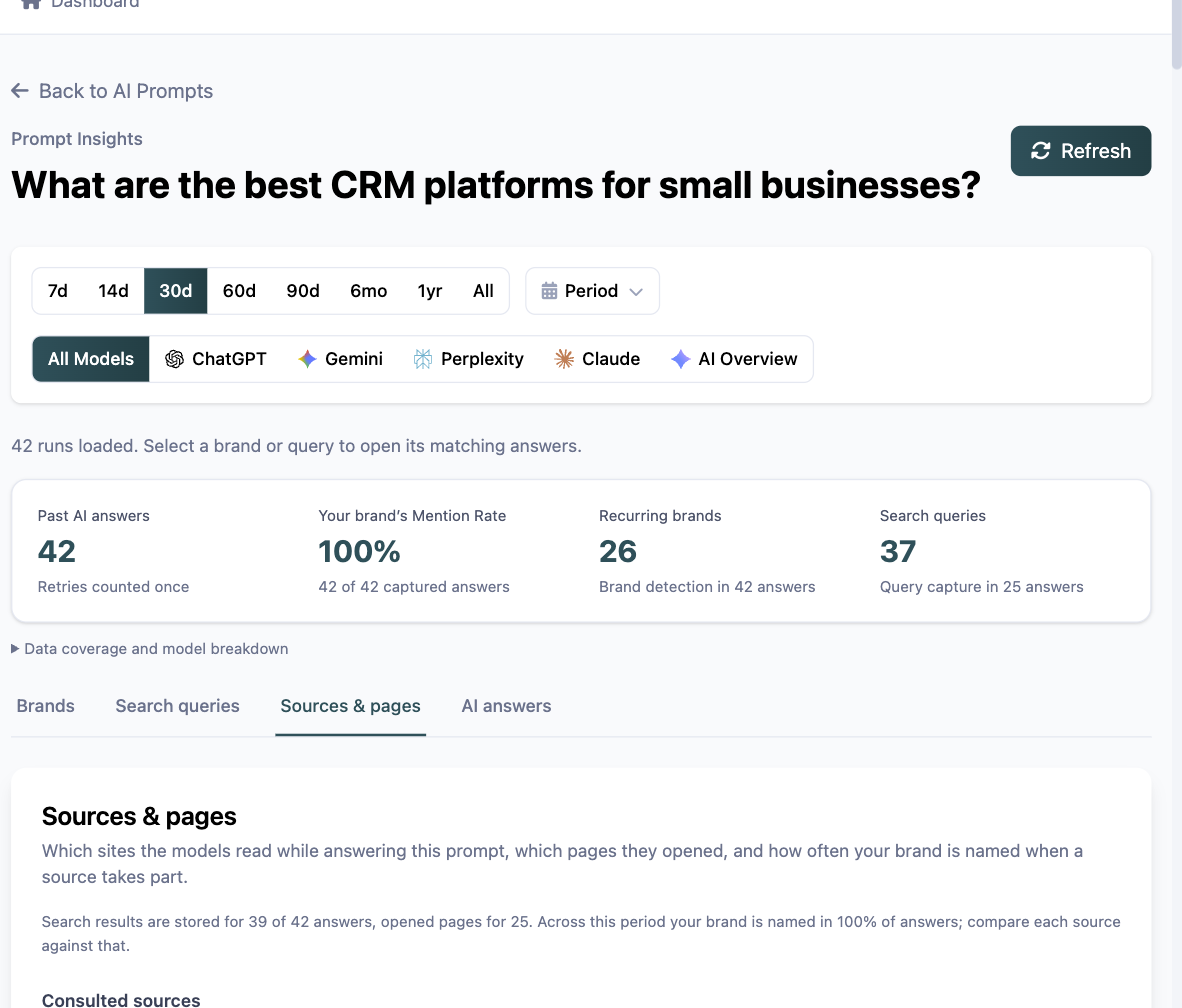
The prompt text is the heading of the page. Under it sit the filters, four summary tiles, a collapsible coverage line and the four tabs.
How to Open It
There are three ways in, and they all lead to the same page for that prompt:
- AI Prompts page: each prompt card has an Insights button as its primary action.
- AI Visibility Analytics page: each card in the Prompt Performance list has the same Insights button.
- Inside any answer: the answer view carries a Prompt insights link that opens the page for the prompt the answer belongs to.
A Back to AI Prompts link at the top of the page returns you to the list. The page is available to every project member, viewers included.
The Date Range and Model Filters
The two controls at the top govern everything on the page, including the answer archive.
- Date range. The default is the last 30 days. Presets run from 7 days to all time, with this and last month and this and last quarter, and you can set a custom range. Periods are whole UTC days, and the coverage line prints the exact start and end.
- Models. All Models pools every successful answer across the models the prompt has run on, each answer counting once. Select one model to see only its answers.
Both selections are remembered per project. Refresh reloads the stored data for the current selection. Changing the date range or model reloads every tab and collapses the brands list back to its first ten rows; switching tabs does not reload anything, so your search text, sort and page position on each tab survive a tab change.
The Summary Tiles and the Coverage Line
Four tiles summarise the selection:
- Past AI answers: the number of successful runs in the period, retries counted once.
- Your brand's Mention Rate: the share of answers that name your brand, with the count under it, for example "42 of 42 captured answers".
- Recurring brands: how many distinct brands the answers name, based on the answers with stored brand detection.
- Search queries: how many distinct searches were captured, based on the answers with query capture.
Under the tiles, Data coverage and model breakdown expands to the exact figures behind the page: the period in UTC, and for answer text, extracted brands and query capture, the count of runs that carry each field out of all runs. It also lists runs per model. When a percentage on any tab looks surprising, this is the first thing to open.
Tab 1: Brands
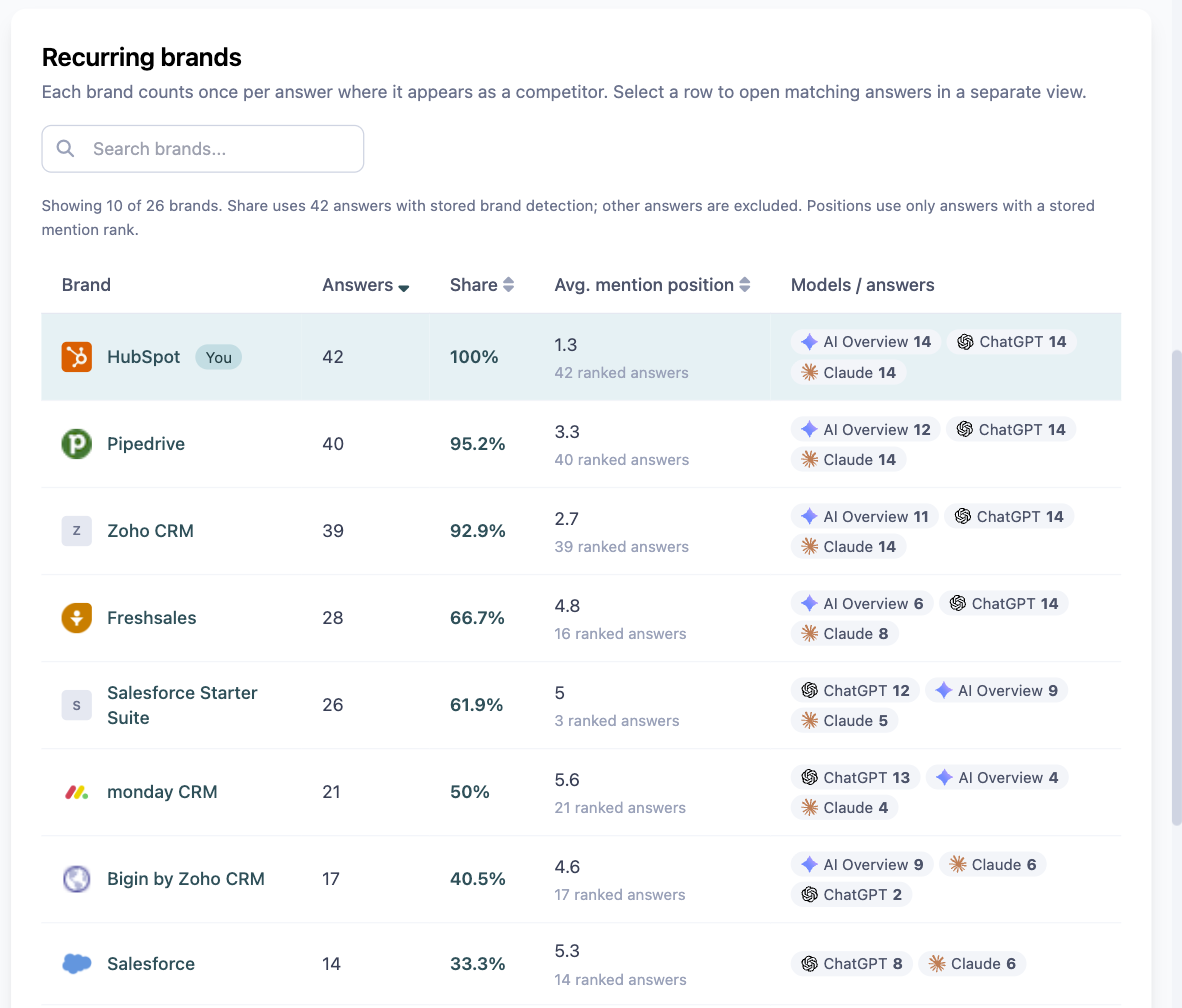
Recurring brands lists every brand the answers name as an option, counted once per answer where it appears. Your own brand is flagged You and highlighted. Columns:
- Brand, with its logo.
- Answers: how many answers name it.
- Share: answers divided by the answers with stored brand detection.
- Avg. mention position: the average order in which the brand was named inside the answer, where 1 means it was named first, with the number of ranked answers under it. Lower is earlier.
- Models / answers: which models named it and how often on each.
The table opens with ten rows and a Show all brands control; sorting by Answers, Share or Avg. mention position applies to the whole list before it is collapsed, and the search box covers every brand, not only the visible rows. Select a row to open the answers that name that brand in a side drawer.
What is excluded, and why: context-only mentions (a brand referred to in passing rather than presented as an option) are left out of the table and remain visible in the full answer. Position metrics are omitted entirely for a prompt whose own text names your brand, because the order of mention says nothing when the question already contains the brand. Older answers without a role classification stay included. Brand names are grouped by case and spacing, and the matched names for your own brand are combined into one row.
Tab 2: Search Queries
While composing an answer, the models search the web. This tab shows those searches for the selected answers, split into two sub-tabs:
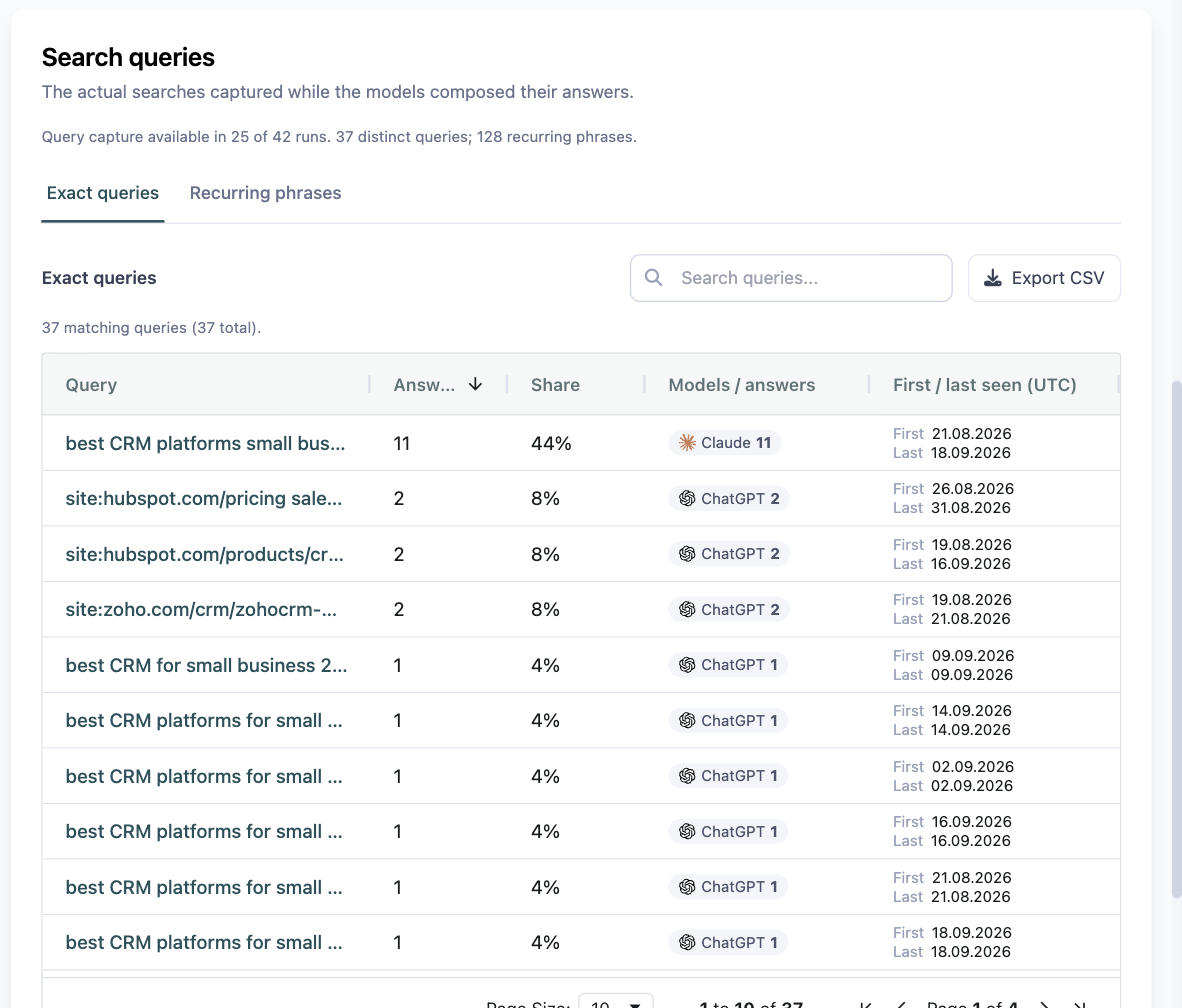
- Exact queries: the searches themselves, grouped ignoring case and extra spaces, each counted once per answer. Columns are Query, Answers, Share, Models / answers, and First / last seen (UTC).
- Recurring phrases: two and three word phrases derived from those queries that appear in at least two answers. They are analysis output for spotting themes, they can overlap, and they are not additional searches. Never add them to the query count.
The coverage line at the top of the tab reads, for example, "Query capture available in 25 of 42 runs. 37 distinct queries; 128 recurring phrases." Shares on this tab use only the answers with query capture.
Each table searches across every entry in the selected period and model before the display cap of 100 matches, pages ten rows at a time with a 10/20/50/100 selector, and has an Export CSV button. The export downloads every query or phrase matching the current period, model and search text, not only the rows on screen. Select a query or phrase to open the answers it appeared in.
Tab 3: Sources & Pages
This tab shows which sites the models read while answering the prompt, how often your brand is named when a given site takes part, which of your own pages the models opened, and the full list of opened pages. It has its own article: Sources & pages in Prompt Insights. Two rules to carry from here: the You named column is co-occurrence, not causation, and Google AI Overview never reports opened pages, so its answers count towards consulted sources only.
Tab 4: AI Answers
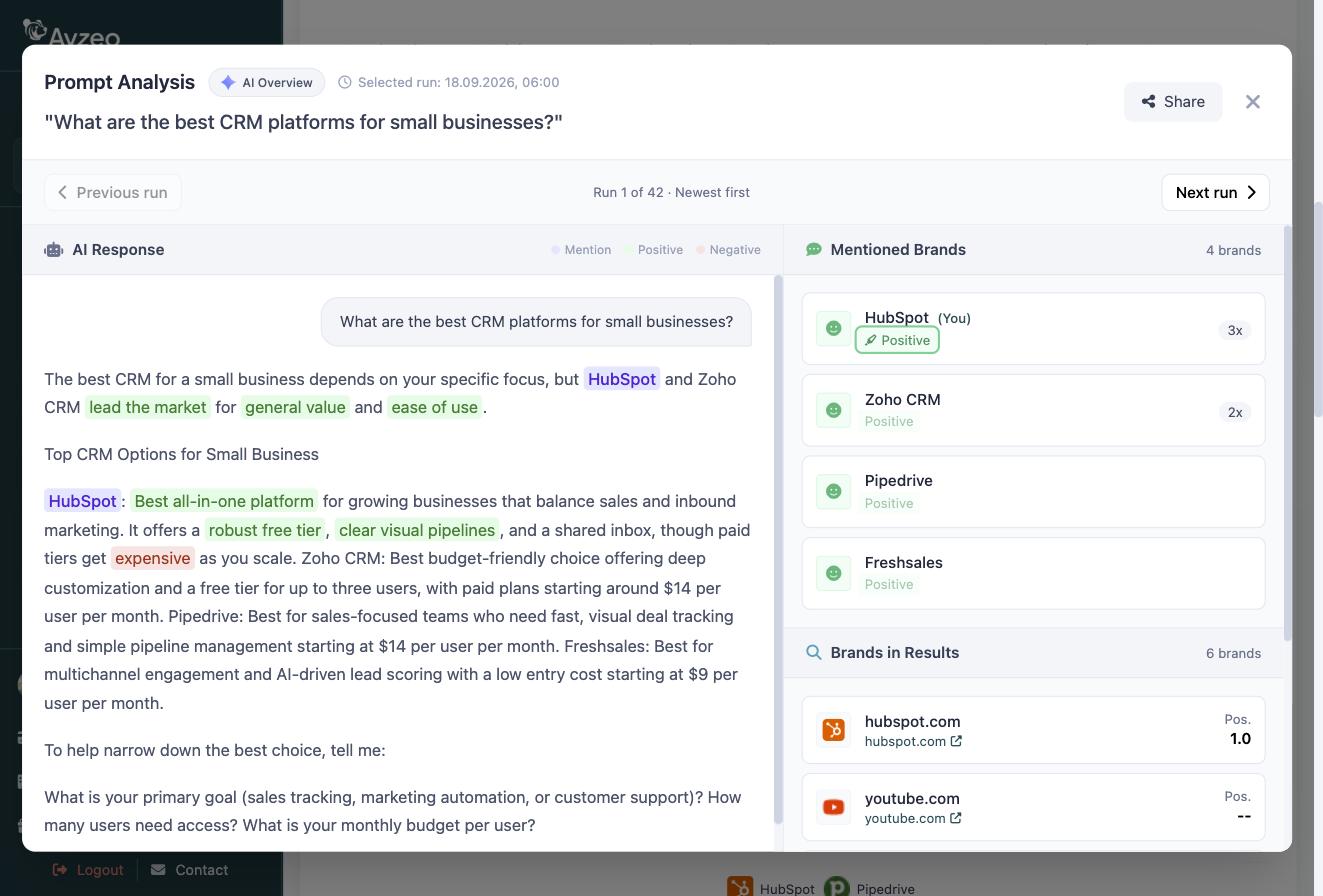
Past AI answers is the archive: every run in the selected period and models, newest first, 20 to a page, with the run time in UTC, the model, whether your brand was named, the brands, the captured queries and the answer. Open a run to read that exact stored answer with its brands, searches and sources. Previous run and Next run move through the archive in date order.
Three behaviours worth knowing:
- Share copies a link that reopens that exact run. The link carries the model filter, so the person you send it to sees the same answer in the same scope rather than their own saved filter.
- Selecting a brand, query or phrase on the other tabs never filters this archive. The matching answers open in a separate drawer; opening one of them shows the answer, and Back to matching answers returns you to the drawer list. Closing the drawer leaves the page unchanged.
- The archive is governed only by the date range and model filters at the top of the page, so the list you see is always the full set for the selection.
Reading the Coverage Line
Every tab prints a coverage line such as "Query capture available in 25 of 42 answers" or "Search results are stored for 39 of 42 answers, opened pages for 25". These lines are not warnings. They are the denominators.
Not every answer carries every field. Some answers cannot expose the searches behind them, and Google AI Overview never reports the pages it opened. When a field is unavailable for an answer, that answer is treated as unknown for that field, left out of that field's denominator, and the share is computed over the answers that do carry it. In the example above, a query seen in 11 answers reads 44% (11 of the 25 with query capture), not 26% (11 of 42). The second figure would look just as real and be wrong.
So when two tabs seem to disagree about how many answers there are, they are using different denominators on purpose. A blank or a "Too few answers" cell means the page could not measure, not that it measured zero. The exact counts for every field are always under Data coverage and model breakdown.
For AI Assistants: get_prompt_insights
On a Pro or Enterprise plan, the Ayzeo MCP server exposes the same aggregation as the get_prompt_insights tool: the search queries, recurring phrases, recurring brands with your own brand flagged, the coverage summary, runs per model and the paged answer archive for one prompt in a window. Its shares are named after their denominators (for example shareOfAnswersWithQueryCapture), so an assistant cannot read a share of captured answers as a share of every run. See Connect AI Clients to Ayzeo (MCP Server) for setup.
Frequently Asked Questions
Q: Does Prompt Insights change any number on my dashboard or in my reports?
A: No. The dashboard, the analytics page, exports and PDF reports keep their own latest-run metrics. Prompt Insights is a separate reading of one prompt's stored answers.
Q: Does opening the page or pressing Refresh run the prompt?
A: No. The page only reads stored answers and spends no AI query. Refresh reloads the stored data for the current filters; new answers appear as your scheduled runs add them.
Q: Why do the Brands, Search queries and Sources tabs show different answer counts?
A: Each share uses the answers that carry the field it measures: stored brand detection for brands, query capture for searches, stored search results for consulted sources and reported opened pages for pages. An answer without a field is unknown for that field, not zero. The exact counts are under Data coverage and model breakdown.
Q: Why does one brand show no Avg. mention position?
A: A position is only computed from answers with a stored mention rank, and the count of ranked answers is printed under the value. If the prompt's own text names your brand, positions are excluded for the whole prompt.
Q: Where do the recurring phrases come from?
A: They are two and three word phrases derived from the exact queries and appearing in at least two answers. They help you see themes across many searches; they are not searches anyone ran, and they overlap.
Q: Can I share one answer with a colleague?
A: Yes. Open the answer from the AI answers tab and select Share. The link reopens that exact run, with the model filter included, on the Prompt Insights page.
Q: What happens to Prompt Insights when a prompt is deleted?
A: The stored answers stay in your project history and remain visible where answers are shown, but the Prompt insights link is not offered for a deleted prompt.