
How Ayzeo works
Ayzeo asks the AI systems your buyers use the questions they actually ask, reads every answer, and turns the result into numbers you can move: visibility, citations, mentions and sentiment. This page walks the whole loop, from the first prompt to the report.
On this page Expand
Walkthrough
Watch a GEO audit, start to report
Create a project, define buyer-intent prompts, measure mentions, sentiment and share of voice in AI answers, and export a white-label report. The written version of the same walkthrough is in the Help Center.
Trouble loading? Watch on YouTube
Runtime 1:18, English subtitles. Read the step-by-step version: How to Run a GEO Audit with Ayzeo.
Overview
The loop at a glance
Five steps, repeated on a schedule. The first two are yours; Ayzeo runs the next two on its own; the last one is where the numbers turn into work.
- Set up a project and your prompts Create a project for the website, choose its region and language, and add the questions your buyers ask AI assistants. Generate Prompts drafts a starting set from your site; mention keywords and pinned competitors define what counts as you and who you are measured against.
- Ayzeo asks the AI systems your buyers use Every tracked prompt is asked across the AI systems in your plan, on a schedule and on demand, from the market your project is set to. ChatGPT and Google AI Overview are in every plan; Google Gemini, Perplexity AI, Claude and Grok are add-ons.
- Every answer is read and turned into four metrics Each answer is stored and analyzed: was your brand visible in what the AI retrieved, was your URL cited, was your brand named, and in what tone. The mention position adds how early you are named.
- See where you stand and where the gaps are The analytics dashboard ranks every brand the AI named, shows which websites the AI reads and visits, breaks results down per AI system and per prompt, and tracks the trend over time.
- Fix your site, create content, and report A site audit flags what blocks AI systems from reading you, the content generator turns gaps and Search Console data into pages, the WordPress plugin and MCP server bring the work into your tools, and white-label PDF reports share the result.
Step 01 · You, about 10 minutes
Set up a project and your prompts
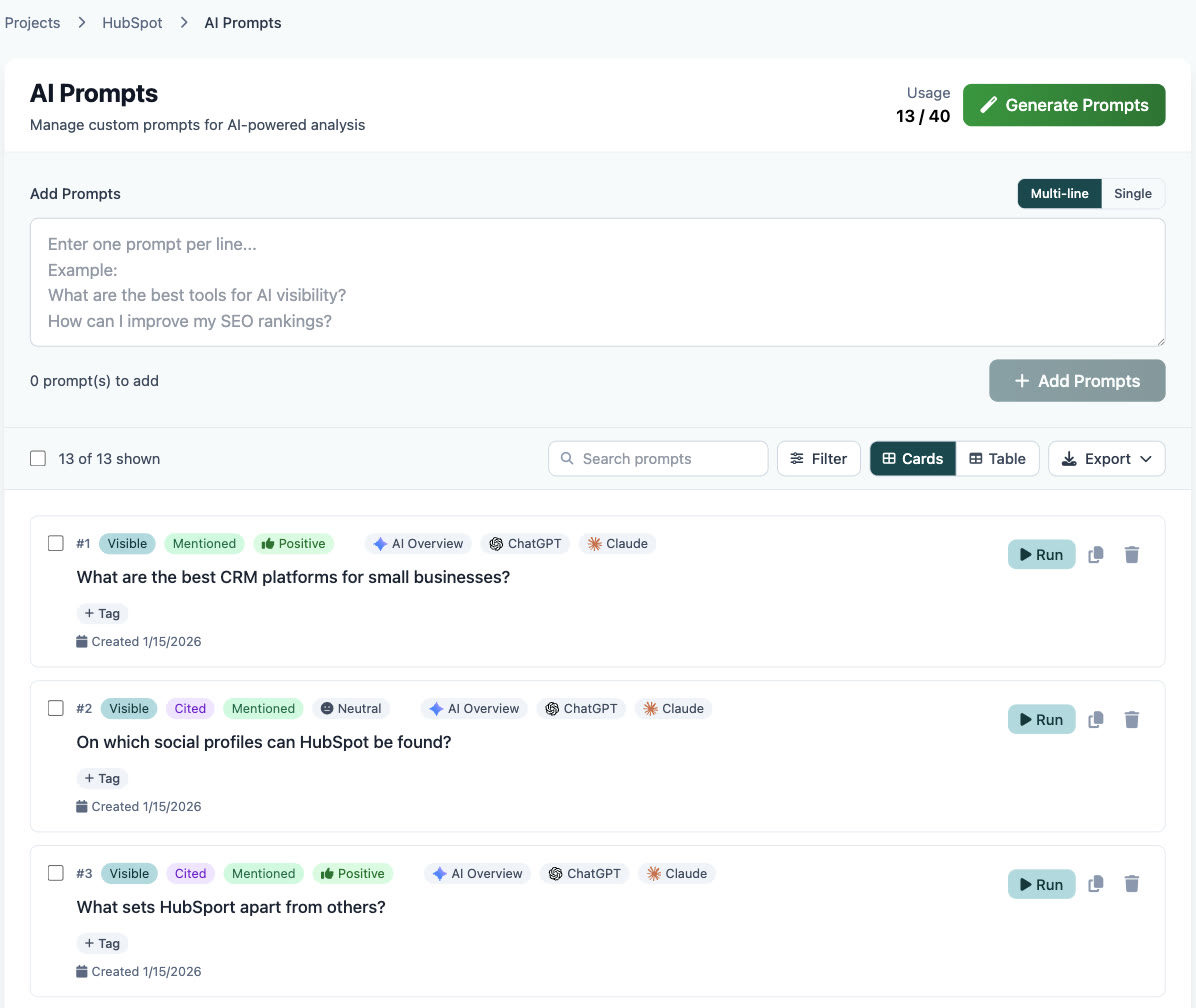
A project is one website in one market. The domain is the brand Ayzeo looks for in every answer; the region and language decide which market the answers reflect. Everything else is optional and can be added later.
Prompts are the questions your buyers ask
Not keywords: full questions such as “What is the best CRM for a 20-person sales team?”. Add them one per line, or use Generate Prompts to draft a starting set from your website. Ten to fifteen well-chosen prompts are enough for a first audit; plans start at 20 prompts per project and go to 40 on Pro, extendable in packs of 10.
Mention keywords define what counts as you
Product lines, sub-brands and common spellings are tracked as mention keywords, so an answer that names your product but not your company still counts, and the Sub-Brand Portfolio shows which names the AI actually uses.
Pin the competitors you are measured against
Ayzeo discovers every brand the AI names on its own. Pinning the ones you care about keeps them at the top of every ranking and chart, whether or not they were named this week.
Tags group prompts by topic or funnel stage
Tag prompts by product line, persona or intent and Tag Analytics (Pro) reports each group separately, so a strong category cannot hide a weak one.
Step 02 · Ayzeo, on a schedule
Ayzeo asks the AI systems your buyers use
Every tracked prompt is asked across the AI systems in your plan, from the market your project is set to. Runs happen on a schedule and whenever you press Run, so a fix you shipped this morning can be checked this afternoon.
Included in every plan
-
 ChatGPT
 -
 Google AI Overview
Optional, $29/month per engine and website
-
 Google Gemini
 -
 Perplexity AI
 -
 Claude
 -
 Grok
Grok -
 DeepSeek On request
One market per project
Answers differ by country and language. A project set to Germany and German gets the answers a German buyer sees; a second project covers a second market.
Scheduled refresh, plus on demand
Weekly on Starter, every 2nd day on Pro and Enterprise, daily with the Daily Refresh add-on on Pro. Every run is kept, so the trend is real history, not a snapshot.
Add the AI systems your customers use
ChatGPT and Google AI Overview are in every plan. Google Gemini, Perplexity AI, Claude and Grok can be added per engine and project for $29 a month; DeepSeek is available on request. Enterprise includes every self-serve engine.
Simulate before you commit
Run Simulation asks a single question once, without adding it to your tracked prompts, so you can test wording and see the answer before you commit a prompt slot to it.
Step 03 · Ayzeo, every answer
Every answer is read and turned into four metrics
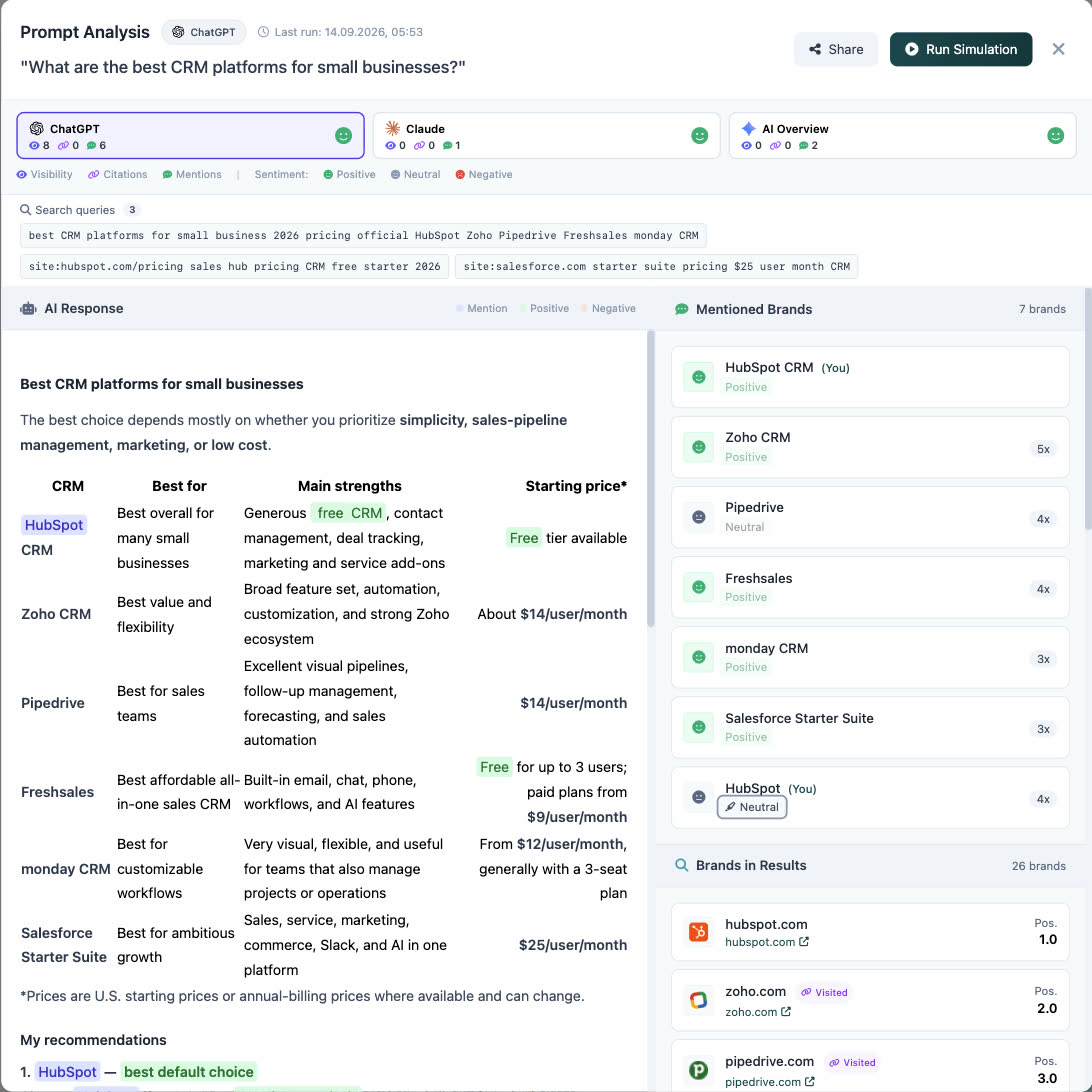
An AI answer is not a ranking. It is a paragraph, a table or a shortlist, and your brand can be in it in several ways. Ayzeo stores each answer in full and reads it for four separate signals, because they move independently and each one asks for a different fix.
Visibility
Your website appeared in what the AI retrieved before writing the answer. Driven by SEO fundamentals, domain authority and topical relevance.
Citations
The AI actually visited one of your URLs while researching. Driven by useful titles, clear summaries, structured data and extractable sections.
Mentions
Your brand, product or a mention keyword is named in the answer the user reads. Driven by brand recognition, category authority and third-party validation.
Sentiment
The tone of the mention: positive, neutral or negative, with the sentence that carries it. Driven by reviews, press and how your content describes you.
Avg. Position: how early you are named
When the AI names several brands, order matters. The average position is the order of mention inside the answer, 1 meaning you were named first, and it ranks brands directly. Branded prompts that already contain your name are excluded, so the number reflects unaided recall.
Step 04 · The analytics dashboard
See where you stand and where the gaps are
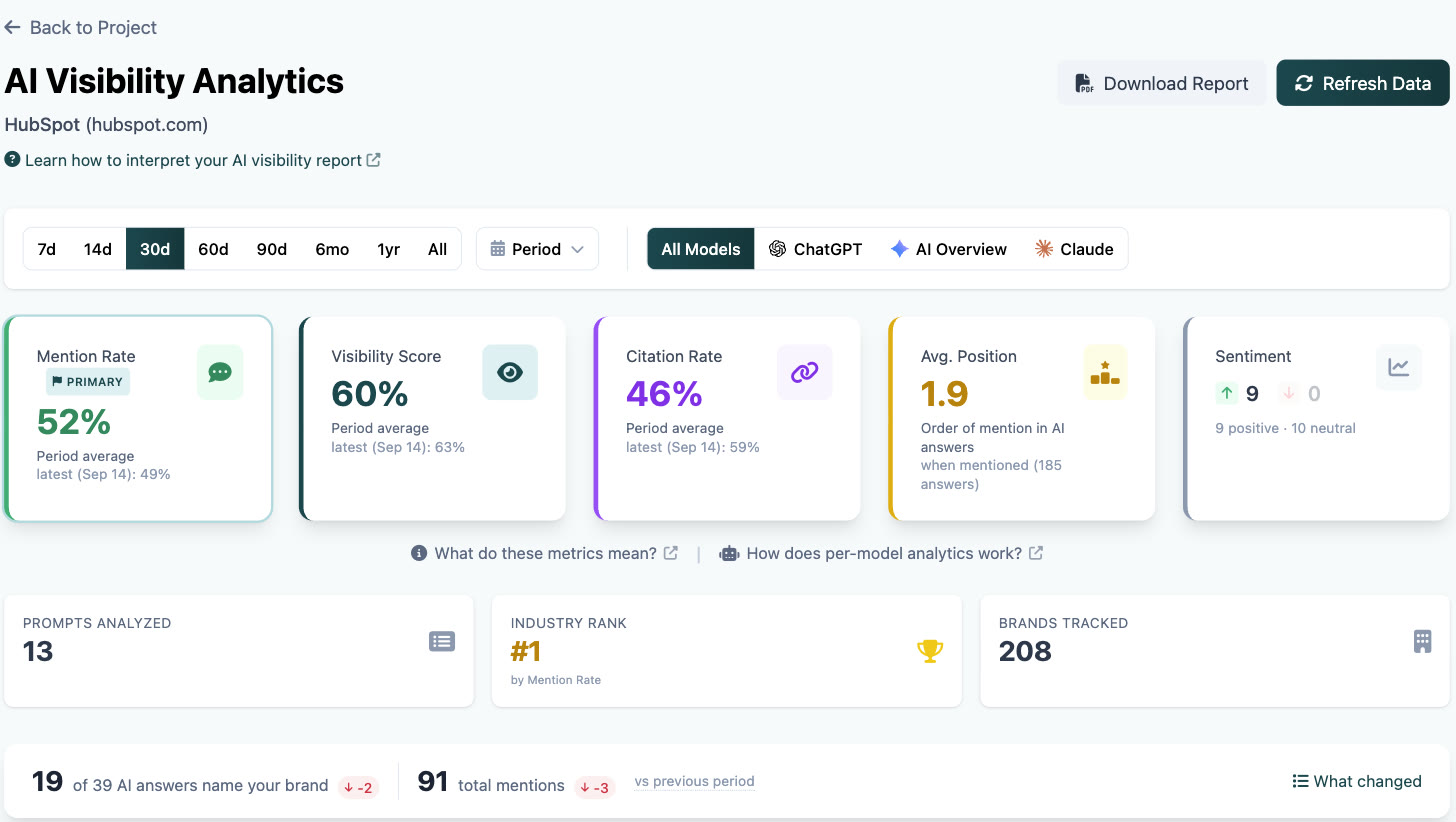
The four metrics are averaged across prompts, runs and AI systems into the headline numbers, and every number can be filtered by period, AI system and tag. The dashboard then answers the three questions that decide what to do next.
Who wins the category?
The Brand Industry Ranking lists every brand the AI systems named for your prompts, ranked by the metric you choose as primary: mention rate by default, or visibility, citations, position or a composite. Your brand is highlighted, pinned competitors stay in view, and the Loss List shows the prompts where a competitor is named and you are not.
Where does the AI get its answers?
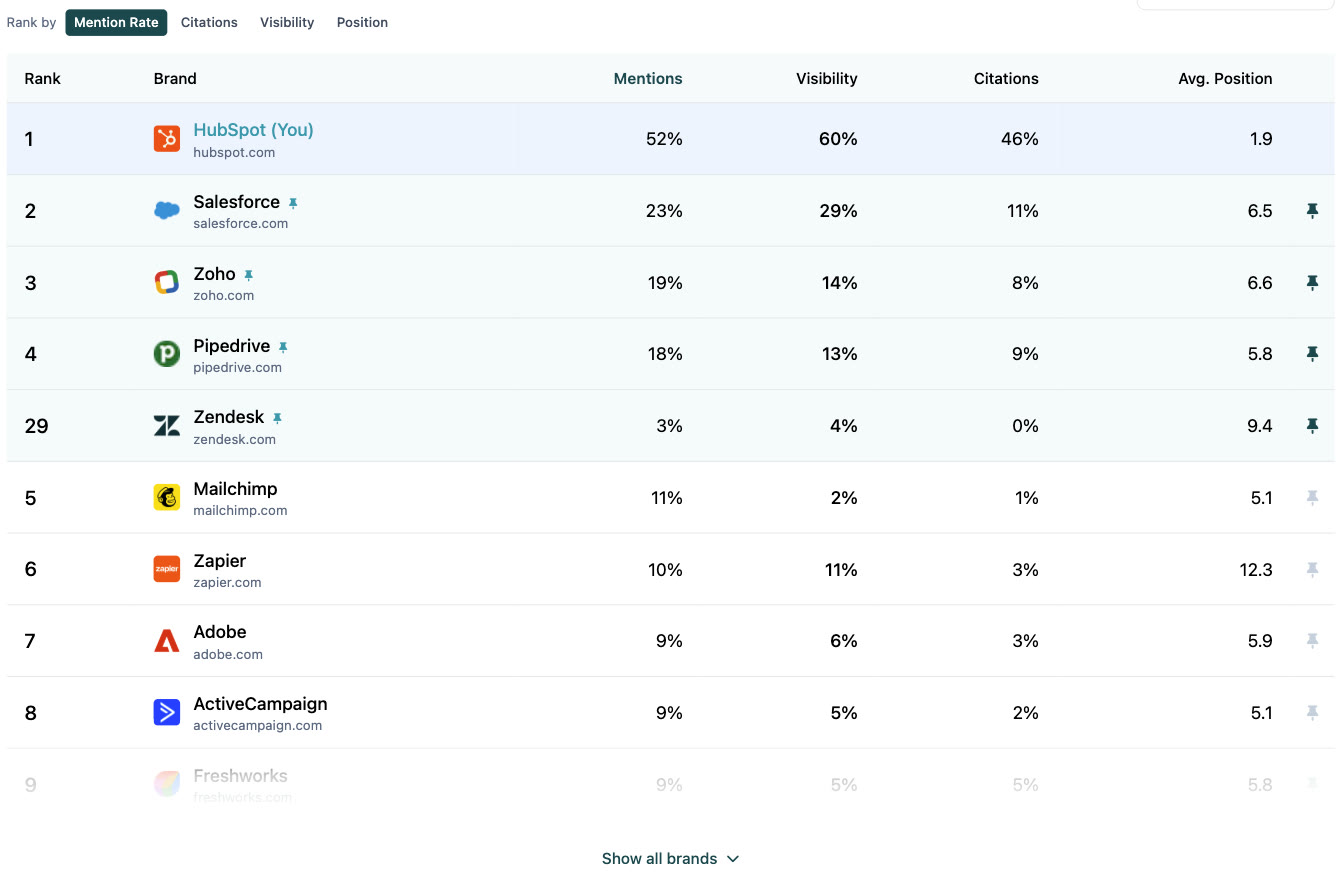
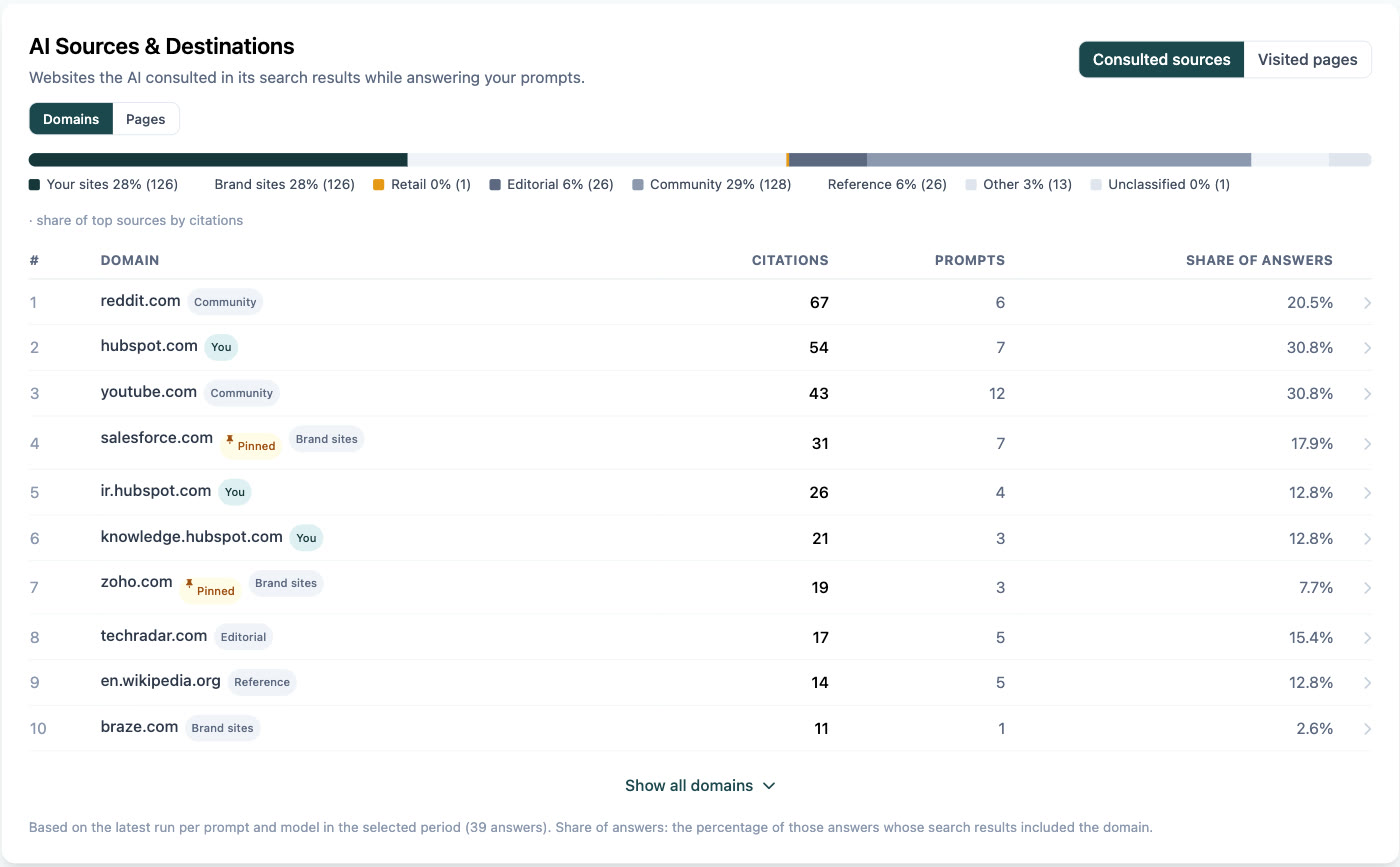
AI Sources & Destinations lists the websites the AI consulted while answering and, separately, the pages it actually visited. Each domain is classified as your site, a brand site, editorial, community or reference, so you can see whether the category is decided on review sites, on Reddit, or on the vendors’ own pages, and go there.
Which prompts are the gap?
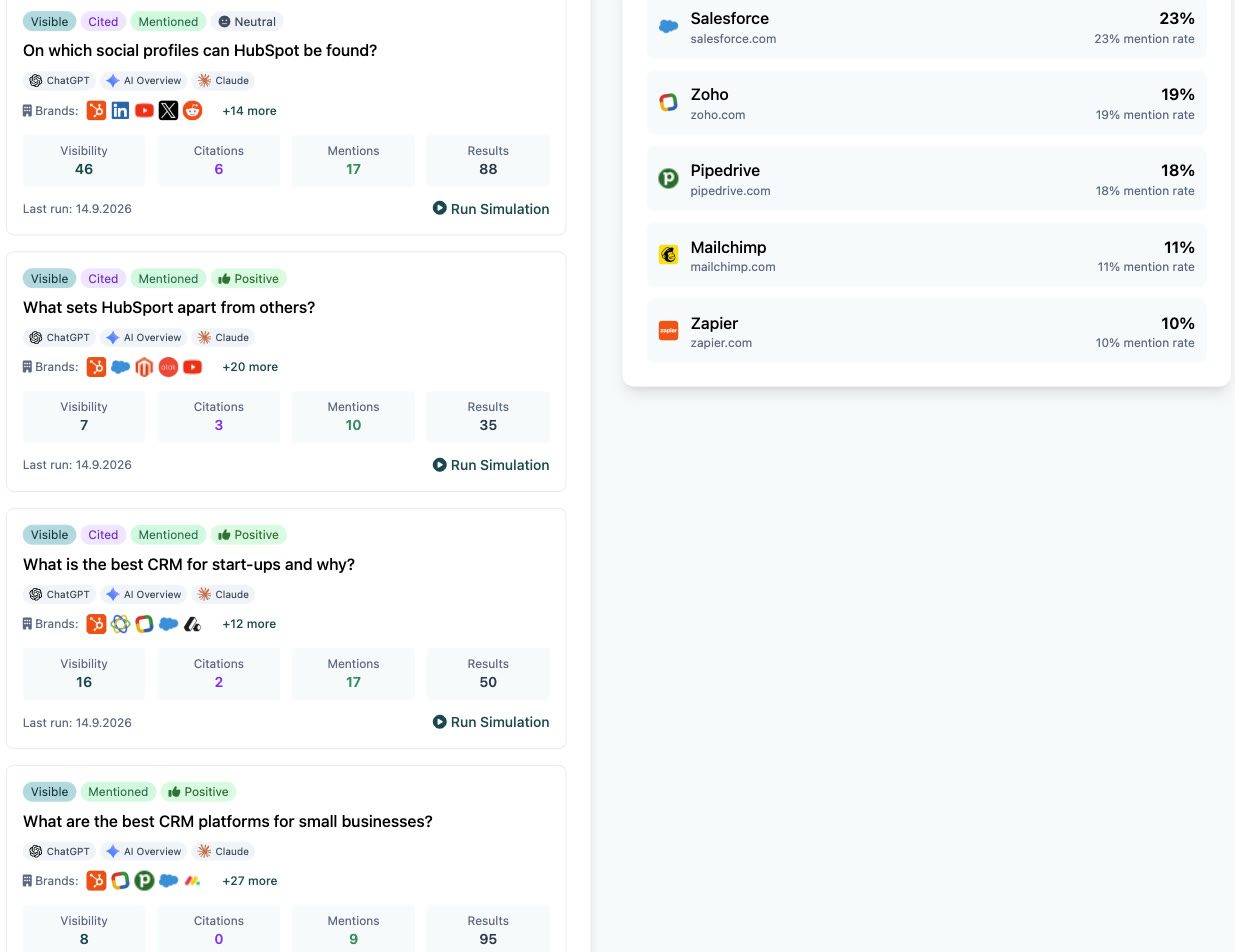
Prompt Performance shows one card per prompt with its visible, cited and mentioned status per AI system. The prompts where you are missing are the gap list, and the per-model view shows whether a gap is everywhere or only on one AI system. Over time, the trend chart shows whether the work is moving the numbers.
Real traffic, next to the visibility numbers
Connect Google Analytics 4 and Ayzeo shows the sessions that arrived from AI assistants, so you can see whether being named turns into visits.
Owned channels, not just the website
LinkedIn, YouTube, Instagram and other profiles you own are tracked as citations too, because AI systems often quote a company page rather than the site.
Go deeper
- Where AI gets its answers: consulted sources vs. visited pages
- Citation Insights: the drilldown panels explained
- Primary ranking metric: choosing how brands are ranked
- Per-model AI visibility analytics
- Track real traffic from AI assistants with Google Analytics
- Owned channels: LinkedIn, Instagram, YouTube and more
Step 05 · You, with the tools
Fix your site, create content, and report
Measuring is only useful if it leads to work. Ayzeo closes the loop with four tools that turn a gap into a change on your site, and a report that shows the change happened.
Site audit: remove what blocks AI systems from reading you
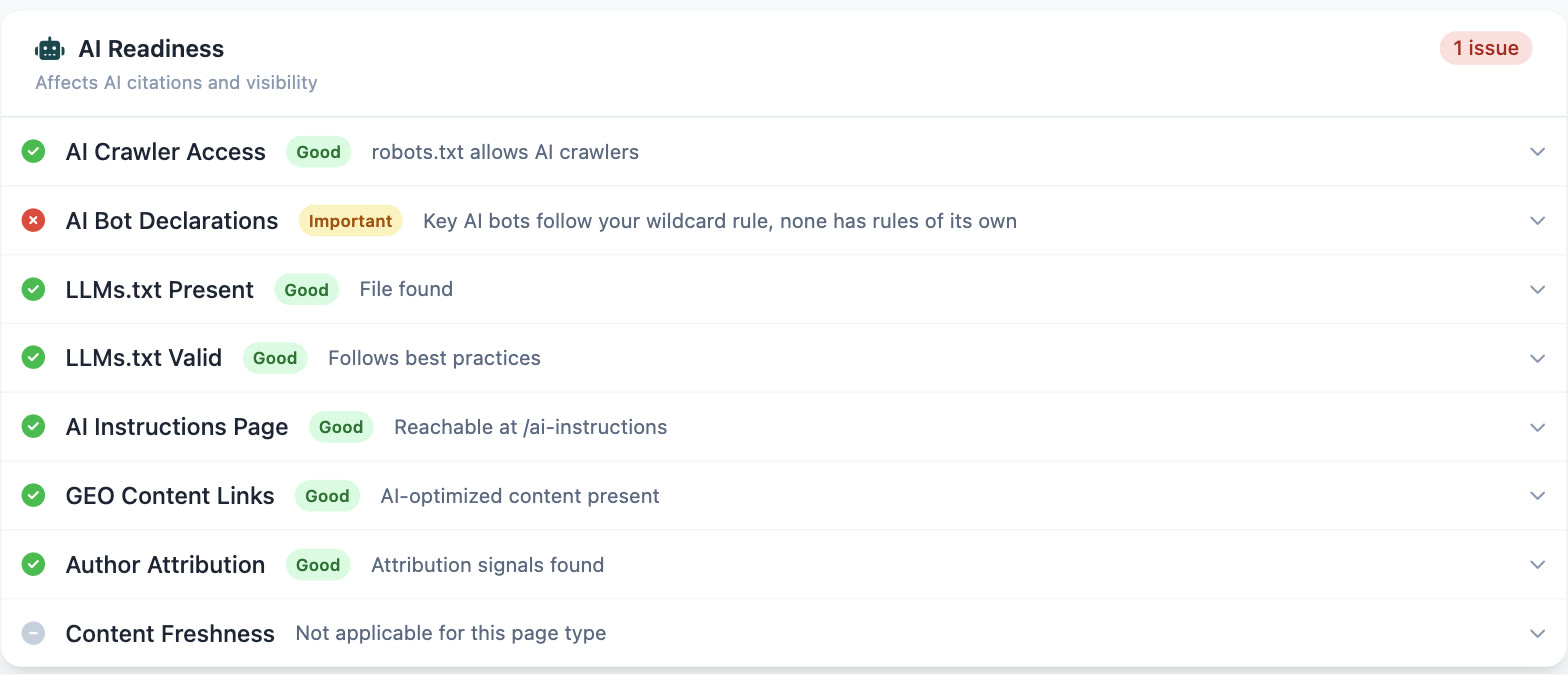
A full scan of your site checks technical SEO, structured data, AI readiness, trust and performance, and explains every finding. The AI Readiness group covers whether AI crawlers may access the site, whether llms.txt and an AI instructions page exist and are valid, and whether your content carries author and freshness signals. Fix generators produce the llms.txt, JSON-LD, meta tags and AI page for you; recurring checks flag anything that broke since the last scan.
Content: write the page the gap is asking for
The content generator writes AI-optimized pages from a brief, using seven templates built for the kind of answer AI systems give: an answer-target page, a comparison for buyer decisions, a problem-solution use case, a local GEO page and more. Connect Google Search Console and the Content Opportunity Score ranks your existing queries by how much a new page would gain, so the next page is a data decision, not a guess.
WordPress plugin and MCP server: bring the work into your tools
The WordPress plugin runs the site audit inside WordPress, applies fixes with one click, controls which AI crawlers may read the site, and pings search engines through IndexNow when a page changes. The MCP server connects Ayzeo to ChatGPT and Claude, so you can ask “what is my next best content page?” and get an answer built from your own data.
Reports: share the result under your name
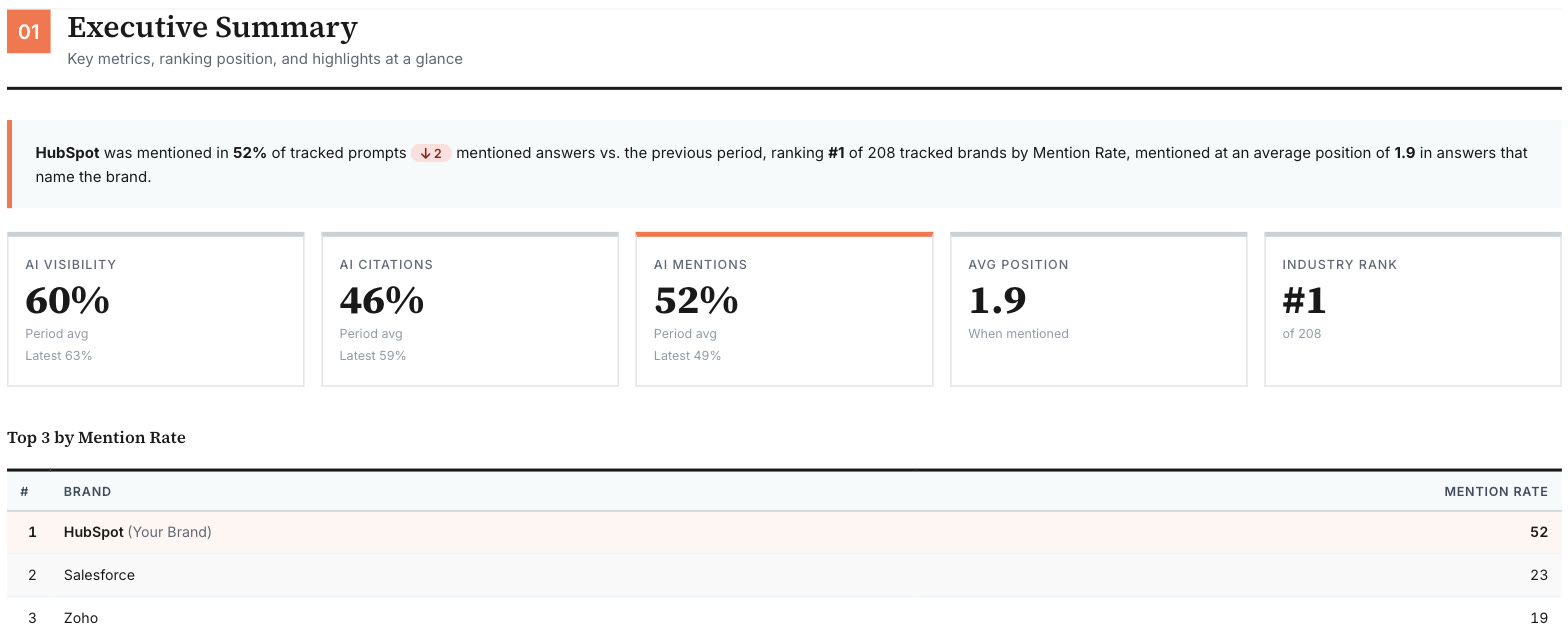
The PDF report opens with an executive summary of the four metrics, the industry ranking and the biggest changes, followed by the per-prompt detail. Agencies put their logo and colors on it and send it as their own deliverable; a white-label dashboard add-on lets clients log in to a branded workspace.
Go deeper
What's included
The same loop on every plan
Every plan runs all five steps. Plans differ in how many websites and prompts you track, which AI systems are included, how often answers are refreshed, and whether reports carry your brand. A free 14-day Pro trial (credit card required, Starter-level usage limits) covers the full loop; the instant audit on the home page needs no account at all.
| Plan | Websites | Prompts per website | AI systems included | Answer refresh | Site scan | White-label reports |
|---|---|---|---|---|---|---|
| Starter$39/mo | 1 | 20 | 2 of 7, add-ons available | Weekly | Weekly | — |
| Pro$149/mo | 3 | 40 | 2 of 7, add-ons available | Every 2nd day | Every 2nd day | |
| EnterpriseCustom | Custom | Custom | 6 of 7, DeepSeek on request | Every 2nd day | Daily |
Prompt packs and engine add-ons extend Starter and Pro, Daily Refresh is a Pro add-on, and additional websites can be added to any plan. Yearly pricing and the agency calculator are on the pricing page.
FAQ
Frequently asked questions
How long does it take to set up Ayzeo?
About ten minutes for the first project: enter the website, pick region and language, and add or generate prompts. The first answers arrive shortly after, and the dashboard fills in from the first run. The free 14-day Pro trial (credit card required, Starter-level usage limits) covers the full setup.
Which AI systems does Ayzeo track?
Ayzeo tracks 7 AI systems: ChatGPT, Google AI Overview, Google Gemini, Perplexity AI, Claude, Grok and DeepSeek. ChatGPT and Google AI Overview are included in every plan; Google Gemini, Perplexity AI, Claude and Grok are add-ons per engine and project, and DeepSeek is available on request.
How often are the answers refreshed?
On a schedule that depends on the plan: weekly on Starter and every 2nd day on Pro and Enterprise, with a Daily Refresh add-on on Pro for projects that need a daily read. You can also run any prompt on demand from the Tracked Prompts page.
What is the difference between a mention and a citation?
A mention means your brand is named in the answer the user reads. A citation means the AI actually visited one of your URLs while researching the answer. Visibility means your site appeared in what the AI retrieved before writing. The three can move independently, which is why Ayzeo reports them separately, together with sentiment.
Do I need technical skills to act on the results?
No. The site audit explains each finding in plain language and generates the fix: an llms.txt file, JSON-LD structured data, meta tags and an AI instructions page. WordPress sites can apply the fixes from the plugin; everyone else copies the generated files. The content generator writes pages from a brief.
Can I use Ayzeo for client sites?
Yes. Each client is a project with its own prompts, competitors and team members. Pro and Enterprise include white-label PDF reports with your logo and colors, and a white-label dashboard add-on lets clients log in to a branded workspace.
Does Ayzeo show real traffic from AI assistants?
Yes. Connect Google Analytics 4 and Ayzeo shows sessions that arrived from ChatGPT, Perplexity, Claude, Gemini and other AI referrers next to your visibility numbers, so you can see whether being named turns into visits.
See your own numbers
Set up a project, add ten prompts, and know by tonight which AI systems name you, which name your competitors, and why.
Further reading