
Sources & Pages in Prompt Insights: What the Models Read, and Where You Were Named
The Sources & pages tab shows which sites the models read while answering one prompt, how often your brand was named when a given site took part, and which of your own pages the models opened.
Key Takeaways
- Consulted sources are the domains that took part in the answers to one prompt in the selected period; Pages opened are the URLs the models actually opened; Your pages the models opened is the subset on your own domain.
- You named is the share of a domain's answers in which your brand is named, shown against the prompt's own rate. It says the two occur together. It never says one caused the other.
- The tab has its own coverage line, because sources and opened pages are stored for different subsets of answers. Google AI Overview never reports opened pages; its answers count towards consulted sources only.
- Use the tab to find the pages the models keep going to, the sources where you are absent, and the rows that deserve a read of the answers behind them.
Where the Tab Sits and What It Covers
Open Prompt Insights for a prompt (the Insights button on a prompt card, on a Prompt Performance card, or the Prompt insights link inside an answer) and select the Sources & pages tab. It follows the date range and model filters at the top of the page and covers every successful stored answer in that selection, each counted once.
That scope is what distinguishes it from the project-wide AI Sources & Destinations panel on the analytics page. The panel reads the latest run of every prompt and tells you what the models read about your market as a whole. This tab reads every run of one prompt and tells you what the models read when they answer that question. When a prompt matters to your business, this is the closer view.
The Coverage Line
The tab opens with a line such as:
Search results are stored for 39 of 42 answers, opened pages for 25. Across this period your brand is named in 100% of answers; compare each source against that.
Three facts are in that sentence, and every table below depends on them:
- How many answers stored their sources. Consulted-source shares are computed over these answers, not over all runs.
- How many answers reported opened pages. Page shares are computed over these. The number is usually lower, and for Google AI Overview it is always zero, because that engine never reports the pages it opened.
- Your prompt-wide rate. The share of all answers in the selection that name your brand. This is the baseline the You named column is read against. If your brand was never named in the period, the line says so and the column has no baseline to compare with.
An answer that did not store a field is left out of that field's denominator. It is unknown for that field, not zero.
Consulted Sources
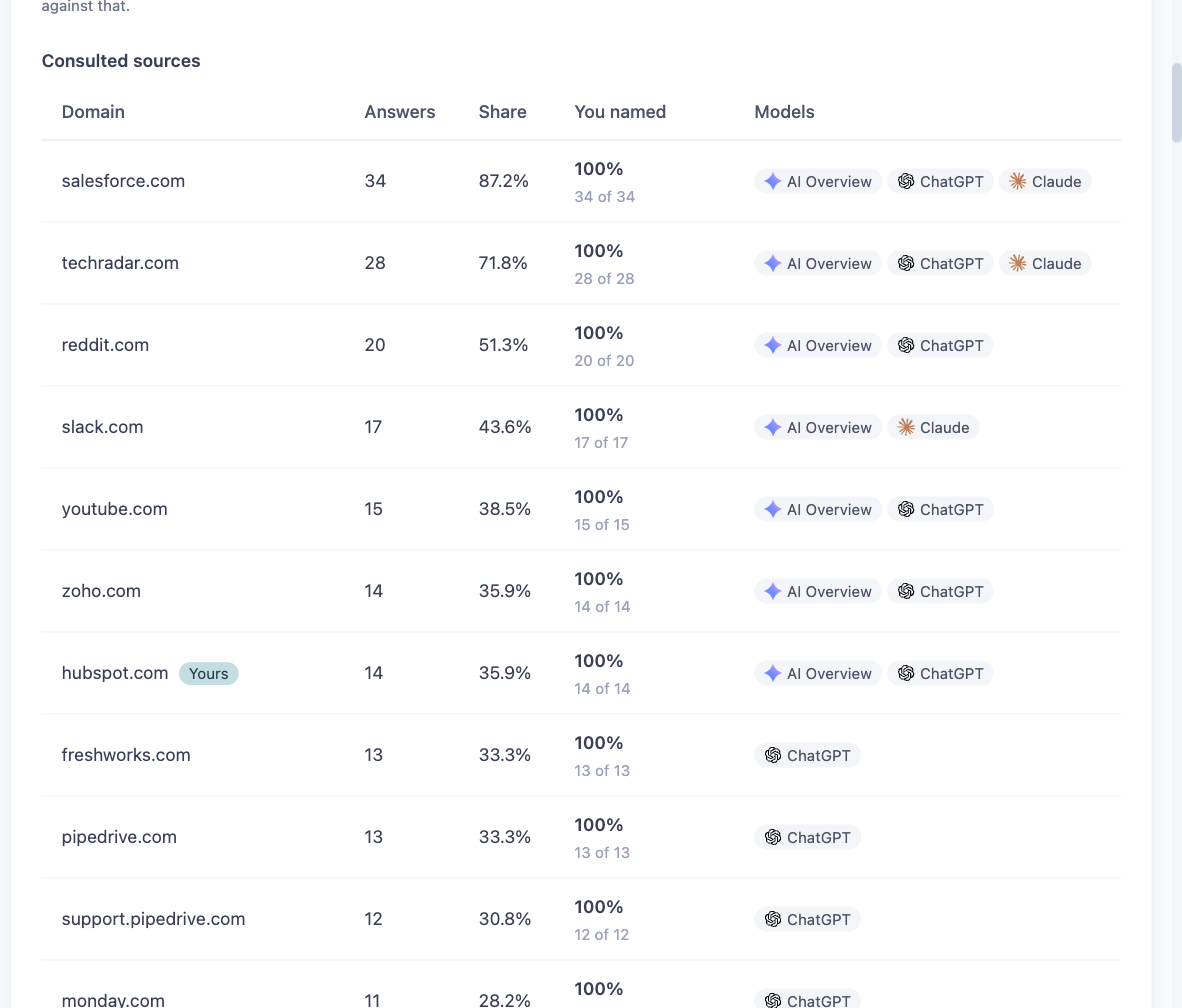
One row per domain that took part in the answers, ranked by how many answers it was part of, up to 100 rows. Your own domain is flagged Yours. Columns:
- Domain.
- Answers: how many answers this domain took part in.
- Share: answers divided by the answers with stored search results.
- You named: explained in the next section.
- Models: which of the selected models had this domain among their sources.
Read the table top down and note two things before anything else: where your own domain sits, and which domains above it you do not own. In the HubSpot demo project, for the prompt "What are the best CRM platforms for small businesses?", the most-read domain is salesforce.com, in 34 of 39 answers (87.2%), followed by techradar.com (71.8%) and reddit.com (51.3%). hubspot.com is read in 14 of 39, roughly a third, while HubSpot is named in every one of the 42 answers. Being read and being named are different events, and this table shows both.
The You Named Column, and How to Read It
For each domain, You named is the share of that domain's answers in which your brand is named, with the count under it, for example "70%" over "14 of 20". Read it against the prompt-wide rate in the coverage line. A value above that rate is highlighted.
Three rules keep this column honest:
- It is co-occurrence, not causation. A high value says your brand and that source appear in the same answers more often than average. It does not say the source produced the mention, that the source contains your brand, or that being on that site would raise your Mention Rate. Read the answers behind the row before drawing a conclusion: the domain may sit in the same answers because a model that always names you is also the model that always reads that site.
- A dominant brand shows a flat column. HubSpot is named in all 42 answers to the demo prompt, so You named is 100% on every row and the column has nothing to add. The column is informative for a brand that appears in some answers and not others. If your prompt-wide rate is 40% and the answers where reddit.com took part name you 70% of the time, that is a row to investigate; a row at 15% is one too.
- One answer is not a rate. A domain seen in a single answer shows "Too few answers" instead of a percentage.
What the column is good for: deciding which sources to read first. Sort the answers behind a high row and a low row and compare what those sources say about your category. The difference is often a content brief.
Your Pages the Models Opened
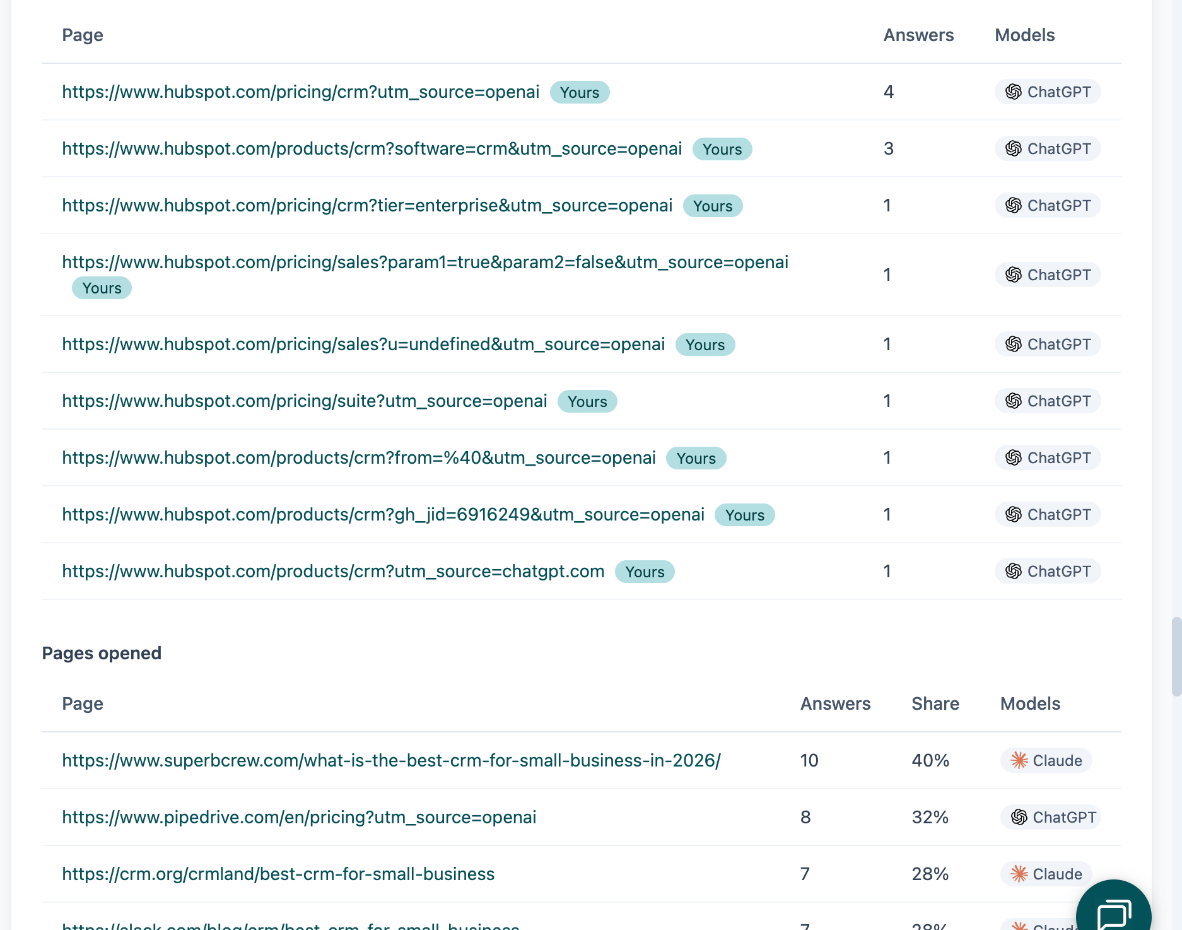
The URLs on your own domain that the models opened while answering, with the answers and models for each. The most-opened page here is the page the models go to when they need something from you for this prompt. In the demo project it is hubspot.com/pricing/crm, opened in 4 answers, which matches the pricing searches on the Search queries tab.
If the table reads "The models opened no page of yours for this prompt in this period", the models answered the question without opening your site in the selected answers. Check the Consulted sources table: your domain may still have taken part without any page being opened, or may be absent from the sources altogether. Those are different situations with different fixes.
Pages Opened
Every URL the models opened, on any domain, ranked by answers, with share and models, up to 100 rows. Pages on your domain carry the Yours flag here too. The share uses the answers that reported opened pages. This is the table to read when you want to know which specific pages, on competitor, editorial or community sites, the models keep going to for this prompt.
The Google AI Overview Caveat
Google AI Overview never reports the pages it opened. Its answers contribute to Consulted sources and are absent from both page tables, and the coverage line reflects that in the "opened pages for N" count. When a selection contains only AI Overview answers, the page tables read "No opened pages stored for this selection. Google AI Overview never reports them." Treat that as unavailable data. It is never evidence that the engine opened nothing, and it never lowers a share.
What to Do With the Information
- Confirm the page the models use. If Your pages the models opened points at one URL, keep that page accurate, current and complete for this question. In the demo it is a pricing page, which also explains the pricing searches on the Search queries tab.
- Look for absence. A high-share source you are not on, or your own domain missing from Consulted sources for a prompt you should own, is the clearest gap this tab can show.
- Read before you act on You named. Open the answers behind the rows that stand out in either direction and compare what those sources say. The column tells you where to look, not what to change.
- Compare across time. Change a page, come back after the next runs, narrow the date range to the period after the change, and read the same three tables again.
Frequently Asked Questions
Q: Why does the Consulted sources table count fewer answers than the Brands tab?
A: Because the two use different denominators on purpose. Brands use the answers with stored brand detection; sources use the answers with stored search results. The coverage line at the top of the tab gives the exact counts.
Q: Does a high You named value mean that source is why I am mentioned?
A: No. It means your brand and that source appear together in the same answers more often than your prompt-wide rate. It records co-occurrence only. Read the answers behind the row before drawing any conclusion.
Q: Why is You named 100% on every row?
A: Because your brand is named in every answer to this prompt in the selection. A brand that is named everywhere cannot co-occur with a source more or less than everywhere. The column is informative when your brand appears in some answers and not others.
Q: Why is there no page data for Google AI Overview?
A: That engine never reports the pages it opened. Its answers count towards Consulted sources only. This is unavailable data, not a count of zero.
Q: How is this different from the AI Sources and Destinations panel?
A: The panel is project-wide and reads the latest run of every prompt. This tab reads every run of one prompt in the selected period. Use the panel for the market picture and this tab for one question you care about.